
HISTORY
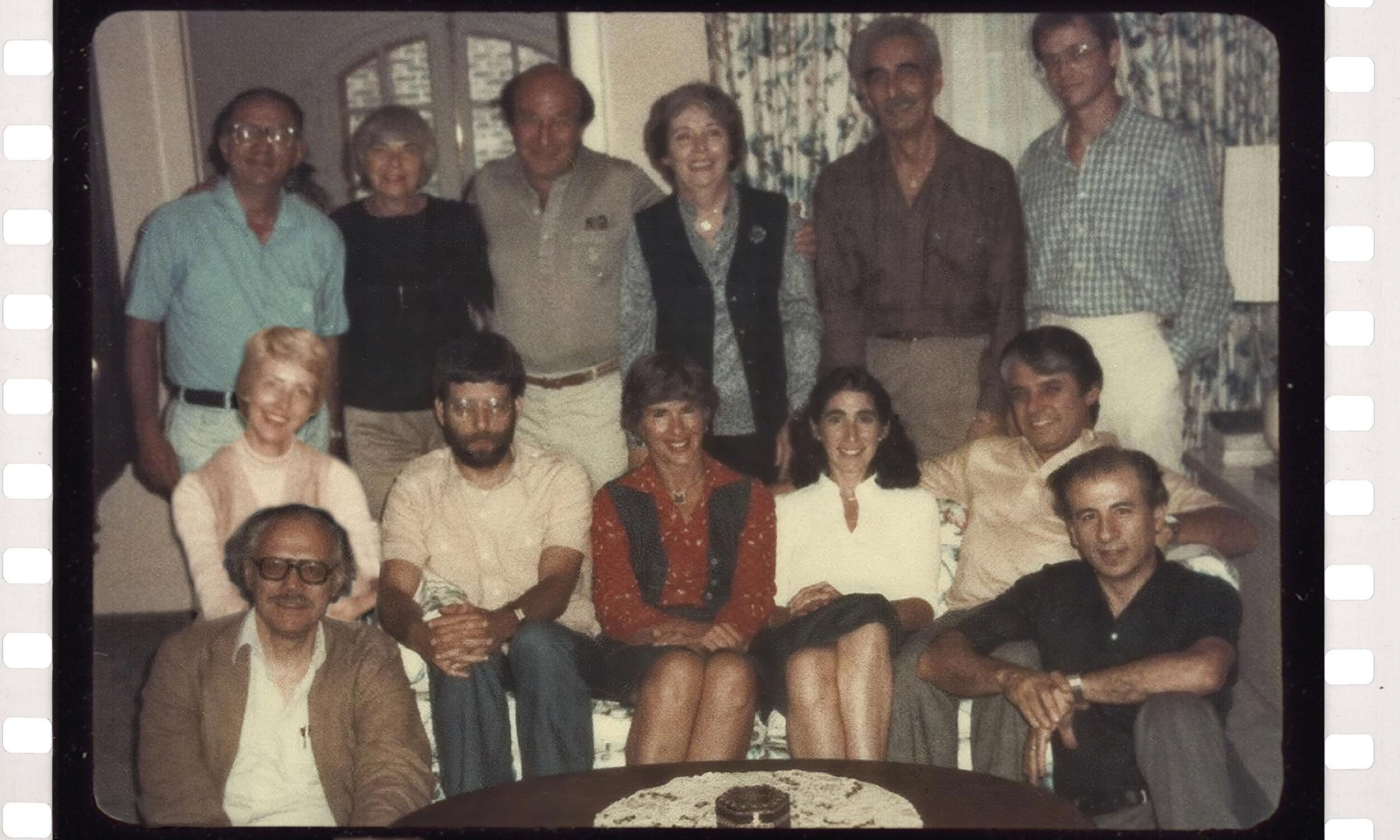
Founded in 1981
The Institute for Clinical Social Work (ICSW) was started by a small group of visionary social workers from leading Chicago-area institutions. The founders were aware that most doctoral programs in social work focused on policy, administration, and research, with little preparation for clinical work. ICSW’s founders understood why: these programs resided within universities, where they were pulled in multiple directions by the needs of the larger institution, its competing departments, and its dependence on grant-winning research.
In 1979, discussions began with the following fourteen prominent social workers:
Carl Bartolucci, Richard Calica, Arthur Diers, James Forkeotes, Connie Goldberg, Tom Kenemore, Janet Kohrman, Helen Lane, Arnold “Arnie” Levin, Paul Reizen, Joseph Palombo, Louise Saltzman, Arthur Schwartz, and Bruce Smith. The group met to begin developing a plan for an independent higher educational institution to offer advanced clinical training.
In 1981, just two years after the initial discussions began, on November 3, 1981, ICSW drafted its articles of incorporation and submitted its application on November 28,1981, for incorporation to the Illinois Board of Higher Education for operating authority. In 1983, twelve faculty members welcomed its first class of six students into the PhD program. On March 19, 2012, the Institutional Actions Council of the Higher Learning Commission approved the MA program in clinical counseling and psychotherapy.
ICSW is proud to be the first and only independent, accredited clinical social work Ph.D. program in the United States. It boasts 130 full- and part-time students and 60 faculty. ICSW remains independent and is fully accredited by the Higher Learning Commission. It is recognized across the nation for its outstanding faculty of scholar-practitioners, dedication to students, and contributions to the field of psychodynamic education.
OUR MISSION
The Institute for Clinical Social Work (ICSW) exists to advance the practice and understanding of clinical social work and counseling through rigorous graduate education rooted in contemporary psychodynamic and psychoanalytic thought. We are committed to developing skilled, reflective clinicians, scholars, and researchers who are equipped to meet the psychological needs of individuals, families, and communities within an ever-changing and complex social landscape.
OUR VISION
To be the leading institution in psychodynamic clinical education, fostering a deep understanding of psychoanalytic frameworks and their application in contemporary practice. We aim to cultivate a community of professionals who are committed to lifelong learning, critical thinking, and the advancement of psychodynamic knowledge.
VALUES STATEMENT
-
Excellence in Education:
We provide comprehensive training in the practical skills of doing psychotherapy from a psychoanalytic/ psychodynamic perspective.
-
Fairness and Justice:
We teach critical social theories that enable our graduates to work effectively with diverse communities within a modern context.
-
Innovation and Leadership:
We strive to produce practitioners, scholars, researchers, educators, and leaders who are at the forefront of psychodynamic clinical social work and counseling.
-
Contemporary Approach:
We emphasize teaching psychodynamic concepts from a contemporary perspective, ensuring our graduates are well-equipped to meet the challenges of today's world.
Presidential Vision
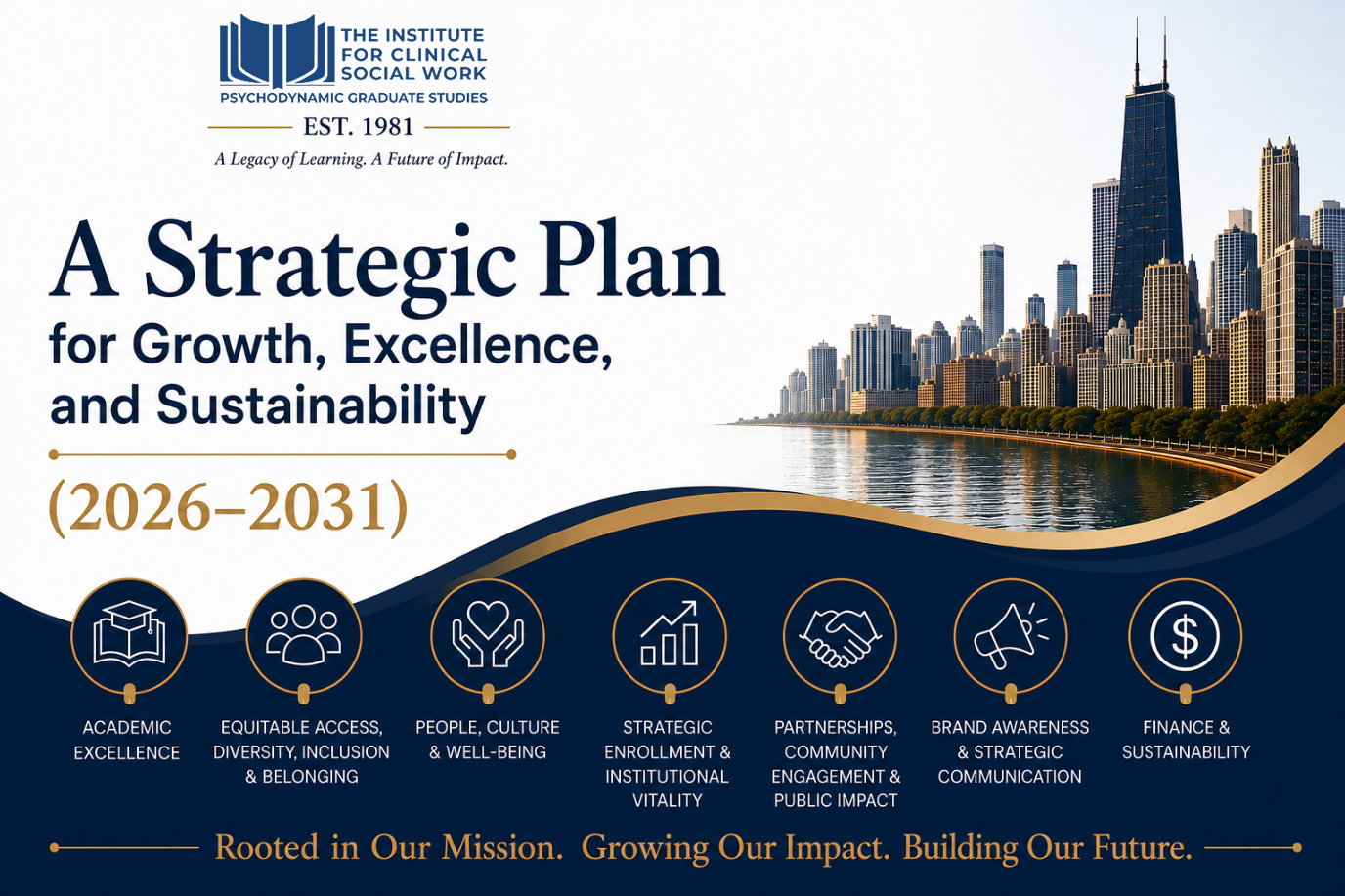
The Institute for Clinical Social Work (ICSW) enters this strategic period grounded in psychodynamic rigor, committed to equity, and oriented toward the future of clinical leadership. This plan affirms our responsibility to educate clinicians who think deeply, engage ethically, and lead social awareness. Through academic innovation, student-centered access, institutional sustainability, and community partnership, ICSW will expand its national presence while strengthening its Chicago roots. The next five years will position the Institute for Clinical Social Work as a model for clinically informed education and research that transforms individuals, communities, and systems.
Mission
The Institute for Clinical Social Work (ICSW) exists to advance the practice and understanding of clinical social work and counseling through rigorous graduate education rooted in contemporary psychodynamic and psychoanalytic thought. We are committed to developing skilled, reflective clinicians, scholars, and researchers who are equipped to meet the psychological needs of individuals, families, and communities within an ever-changing and complex social landscape.
Vision
To be the leading institution in psychodynamic clinical education, fostering a deep understanding of contemporary psychodynamic and psychoanalytic frameworks and their application in contemporary practice. We aim to cultivate a community of professionals who are committed to lifelong learning, critical thinking, and the advancement of psychodynamic knowledge.
Excellence in Education
We provide comprehensive training in the practical skills of psychotherapy from a psychoanalytic/psychodynamic perspective.
Fairness and Justice
We teach critical social theories that enable our graduates to work effectively with diverse communities within a modern context.
Innovation and Leadership
We strive to produce practitioners, scholars, researchers, educators, and leaders who are at the forefront of psychodynamic clinical practice and research.
Contemporary Approach
We emphasize teaching psychodynamic concepts from a contemporary perspective, ensuring our graduates are well-equipped to meet the challenges of today’s world.
PILLAR 1: Academic Excellence, Innovation, & Student Success
Priority 1: Curriculum Relevance & Program Growth
- PhD Program Review completed; ≥75% recommendations implemented by 2029
- Add 1 new academic or certificate program by 2031
- ≥85% student satisfaction on curriculum quality
- +15% growth in continuing education by 2031
Priority 2: Student Success & Support
- Student Advisory Council active with quarterly engagement by 2027
- Biannual student feedback loop implemented and tracked
- Retention/graduation rates increase by 10% by 2030
- Scholarship funding +25% by 2031
Priority 3: Field Education & Partnerships
- Field placement review completed by 2027
- +10 high-quality community partnerships by 2030
- +25% increase in diverse placement sites
- ≥90% student satisfaction in field education
Priority 4: Faculty Excellence & Teaching Innovation
- Faculty onboarding program launched by 2027
- 3–4 faculty development offerings annually (≥75% participation)
- Measurable increase in faculty diversity by 2031
Priority 5: Learning Innovation & Communication
- Launch institutional newsletter by 2027
- Develop 2–3 hybrid/online offerings by 2029
- +15–20% improvement in student experience/communication satisfaction
PILLAR 2: Equitable Access, Diversity, Inclusion & Belonging (EDIB)
Priority 1: Access & Affordability
- Increase enrollment of underrepresented students annually
- Expand need-based aid (tracked yearly growth)
- Reduce retention gaps across student groups
Priority 2: Inclusive Recruitment
- Inclusive recruitment framework implemented by 2027
- 100% admissions staff trained in equity-informed practices
- Year-over-year improvement in applicant diversity
Priority 3: Equity Accountability
- Policy equity audit completed by 2027
- Equity metrics included in annual dashboard by 2028
- Climate/belonging indicators show measurable improvement
PILLAR 3: People, Culture, & Well-Being
Priority: Culture of Care & Institutional Health
- Annual employee engagement assessment
- Increase participation in community spaces (El Batey, circles) increases yearly
- Staff/faculty retention improves or remains stable
PILLAR 4: Strategic Enrollment & Institutional Vitality
Priority: Sustainable Enrollment Growth
- 5% annual enrollment growth
- Admissions and financial aid audit completed by 2027
- Pipeline partnerships expanded by 2029
- Enrollment dashboard implemented and reviewed quarterly
PILLAR 5: Partnerships, Community Engagement & Public Impact
Priority: External Engagement & Visibility
- +10% growth in community partnerships annually
- +15–20% increase in public program participation
- ≥35% alumni engagement rate
- Assess the feasibility of establishing an ICSW community clinic
PILLAR 6: Brand Awareness & Strategic Communication
Priority: Institutional Visibility & Identity
- Increased national visibility (applications, partnerships, media mentions)
- Consistent institutional messaging across platforms
- Growth in digital engagement metrics annually
PILLAR 7: Institutional Sustainability & Operational Excellence
Priority: Financial Health & Operational Strength
- Operating margin ≥ 5%
- Clean annual audit
- Fundraising growth ≥ 15% annually
- Reduction of student accrued revenue ≥ 20-25% annually
- Evaluate the feasibility, financial sustainability, and strategic alignment of securing a permanent location for ICSW
WE ARE
Psychodynamic professionals and practicing clinicians who are nationally recognized as leaders in the field.

Amy Eldridge, PhD
Dean Emerita, Institute for Clinical Social Work
President, International Association for Psychoanalytic Self Psychology
Gabriel Ruiz, MA
Faculty, Institute for Clinical Social Work
Private practice in psychoanalysis and psychotherapy
Professor Ruiz teaches the highly popular course on making use of dreams in clinical process.
Committed to Social Justice

Lynn McIntyre, PhD, LCSW
Faculty, Institute for Clinical Social Work
As a new graduate student working in the public schools in a poor African American community, I witnessed a principal tell his graduating 8th graders that his “dream “ for them was that one day they would graduate from high school. I immediately thought of the social justice issue at hand; the low expectation presented for these students in contrast to those in neighboring, affluent White communities. That year, I made the decision to enter ICSW’s PhD program to address these psycho-social issues. ICSW’s academic preparation allowed me to use my skills to deepen the care given to marginalized youths. Now, as a professor at ICSW, I share with my student colleagues the satisfaction that a rigorous psychological training program, infused with cultural awareness can provide.
Compassionate Practice

De’Asia Thompson, LISW-S
PhD Student, Second-Year, Institute for Clinical Social Work
DeAsia focuses on improving the mental health and well-being of Black women and other women of color. At her practice, she focuses on providing a safe space for clients to heal as they navigate various terrains such as race, gender, sexuality, and other intersectional places they meet that contributes to their depression and anxiety.
Recognize and Celebrate Diversity
Diversity Statement
The Institute for Clinical Social Work is an Affirmative Action/Equal Opportunity Employer. The Institution does not discriminate in access to its educational programs and activities, or with respect to hiring or the terms and conditions of employment, on the basis of race, color, national origin, religion, sex, gender identity and expression, political affiliation, age, disability, veteran status, genetic information or sexual orientation.
Statement on Racial Equity
(June 2, 2020) The tragedy of George Floyd’s death in Minneapolis reveals, once again, the effects of institutionalized racism has become a flashpoint for justified lack of trust that will be seen and treated as a symptom of implicit bias in all systems. The Institute for Clinical Social Work understands that institutional racism is not isolated to police departments and hears the protests as a call to action to work for racial equity in our nation, in our communities, and in our institutions of higher education.
The Institute for Clinical Social Work believes in equal access to education, health care, and the right to exist and calls upon its members to reflect individually on what actions we each can take to seek justice and to commit collectively to create an institute that lives its values.
We must turn our listening ear and our great capacities for empathy to the voices of African American people who do not feel safe, to black and brown mothers and fathers who send their children out in the world and must tolerate unyielding fear for them, and to our colleagues, co-workers, students, and partners who are generous enough to share their experience, and we learn from each other.
We use our self-awareness to know that if we blame the police and leave it at that, we are avoiding our own privilege and our own responsibility to act, speak up, demand equity. IF we stay silent, we are complicit. Our education and work seek to amplify all human stories and perspectives.
Here are some specific action steps that the Institute for Clinical Social Work will implement as we continue to live our mission and work towards combatting institutionalized racism:
Academic curricular: We will review our curriculum to include a greater diversity of authorship in psychodynamic and psychoanalytic theories and practices.
Community education: We will organize a summer training on implicit bias in theorizing, agencies, and practices.
Faculty development: We will focus on Diversity and Inclusion and include training on White privilege and racial inequity at our next Faculty Retreat.
Recruitment: We will focus recruitment efforts to reach underrepresented groups in our faculty, student, and staff recruitment efforts.
We must collectively acknowledge that institutionalized racism can only exist if we do not acknowledge our own privileges and commit to working together to dismantle social injustices within all institutions. We recognize that it begins here, it begins with us at the Institute for Clinical Social Work. Please join us in our commitment to racial equity.
ICSW recognizes the need to diversify the field of clinical counseling and supports and celebrates diverse students through the Presidential Scholarship.

Doranna Tindle
PhD Student, Institute for Clinical Social Work
Doranna Tindle is a mother, clinician, teacher, and transformational leader who is deeply committed to helping people use their bodies and stories to heal.