
Neuroscience and
Psychodynamic
Psychotherapy
The Joseph Palombo Center 24‑Week Certificate Program integrating neuroscience, attachment, affect regulation, trauma, and psychodynamic formulation.
Program Overview
A clinically useful integration of neuroscience and psychodynamic psychotherapy designed to help clinicians translate observation into formulation, timing, and intervention without reducing psychotherapy to biology.
What Participants Gain
Clinical Clarity
A repeatable framework for moving from observation to formulation to intervention.
Deeper Integration
Connect neuroscience with psychodynamic listening without losing complexity or meaning.
Immediate Relevance
Apply concepts directly to trauma, dysregulation, attachment, enactment, rupture, and repair.
Distinctive Educational Method
| Program Pillar | Clinical Function |
|---|---|
| Palombo's Levels of Analysis | Objective data, developmental context, and subjective experience remain distinct yet integrated. |
| Complex Adaptive Self | The self is taught as embodied, relational, nonlinear, and adaptive. |
| Clinical Translation Sequence | Observation → Empirical Model → Psychodynamic Inference → Intervention. |
| Two‑Person Neuro‑Relational Field | Treatment is approached as a living dyadic system shaped by rupture and repair. |
Recurring Formulation Sequence
| Step | Faculty Question | Student Competency |
|---|---|---|
| 1. Observation | What is visible before interpretation? | Distinguishes data from inference. |
| 2. Empirical Model | Which processes organize the moment? | Uses neuroscience cautiously and specifically. |
| 3. Psychodynamic Inference | What may this mean? | Links empirical models to subjectivity and development. |
| 4. Intervention | What can this dyad metabolize now? | Selects timing and intervention level. |
24‑Week Curriculum Overview
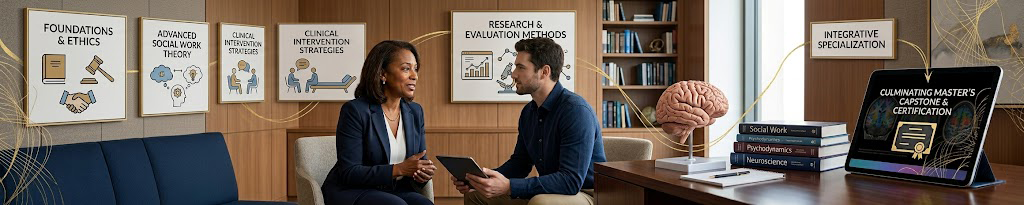
| Phase | Weeks | Summary |
|---|---|---|
| Foundations | 1‑6 | Neuroanatomy, autonomic regulation, affect systems, attachment. |
| Self‑System Organization | 7‑8 | Implicit relational knowing and complex adaptive self. |
| Memory & Networks | 9‑12 | Implicit and explicit memory, major neural networks. |
| Therapeutic Dyad | 13‑16 | Co‑regulation, predictive processing, affective communication. |
| Trauma & Enactment | 17‑20 | Trauma, dissociation, defensive organization. |
| Repair & Integration | 21‑24 | Clinical decision‑making and integrated formulation. |
Participant Learning Outcomes
- Formulate clinical material across Levels of Analysis.
- Use neuroscience concepts to clarify formulation and timing.
- Differentiate implicit process, memory, and identity.
- Recognize regulation and repair opportunities.
- Formulate trauma and dissociation patterns.
- Apply intervention timing more effectively.
- Write integrated case formulations.
Teaching Format & Program Components
| Component | Description |
|---|---|
| Weekly Seminars | Faculty-led learning and discussion. |
| Assigned Readings | Core, bridge, and advanced readings. |
| Clinical Vignettes | Applied formulation exercises. |
| Assessment | Quizzes, written work, and capstone. |
Admissions & Program Details

| Program dates | Tentatively, August 2026 to May 2027 |
| Format | The program is virtual online. |
| Schedule | Fridays, from 1 PM to 4 PM (Central Time) |
| Tuition | Tuition is $3100 |
| CE status | 72 hours of CEU credit hours are approved, pending completion of the certificate program. |
| Application Process | The application includes a personal statement and a non-refundable $50 fee. Deadline for complete applications is July 30, 2026 |
| Program contact | William D. Gieseke, Ph.D., Director of the Joseph Palombo Center for Neuroscience and Psychoanalytic Clinical Social Work. wgieseke@icsw.edu 847.446.0240 |
Certificate Requirements
| Attendance | 80–85% attendance standard. |
| Preparation | Completion of weekly readings and preparation. |
| Assessment | Unit quizzes and competency review. |
| Clinical Formulation | Written application of program frameworks. |
| Capstone | Faculty-reviewed final case formulation. |
Frequently Asked Questions
Faculty & Leadership
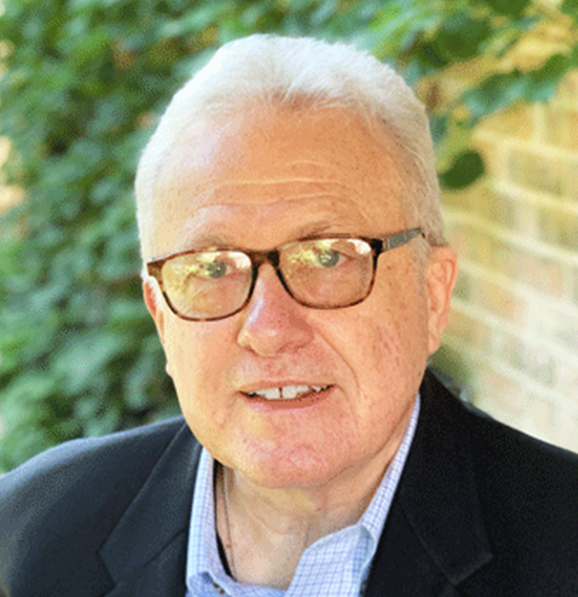
William D. Gieseke, Ph.D.
Executive Director
Dr. William “Bill” Gieseke is the Executive Director and a founding member of the Palombo Center Advisory Committee. He is a Core Faculty member at the Institute for Clinical Social Work.